

Introduction
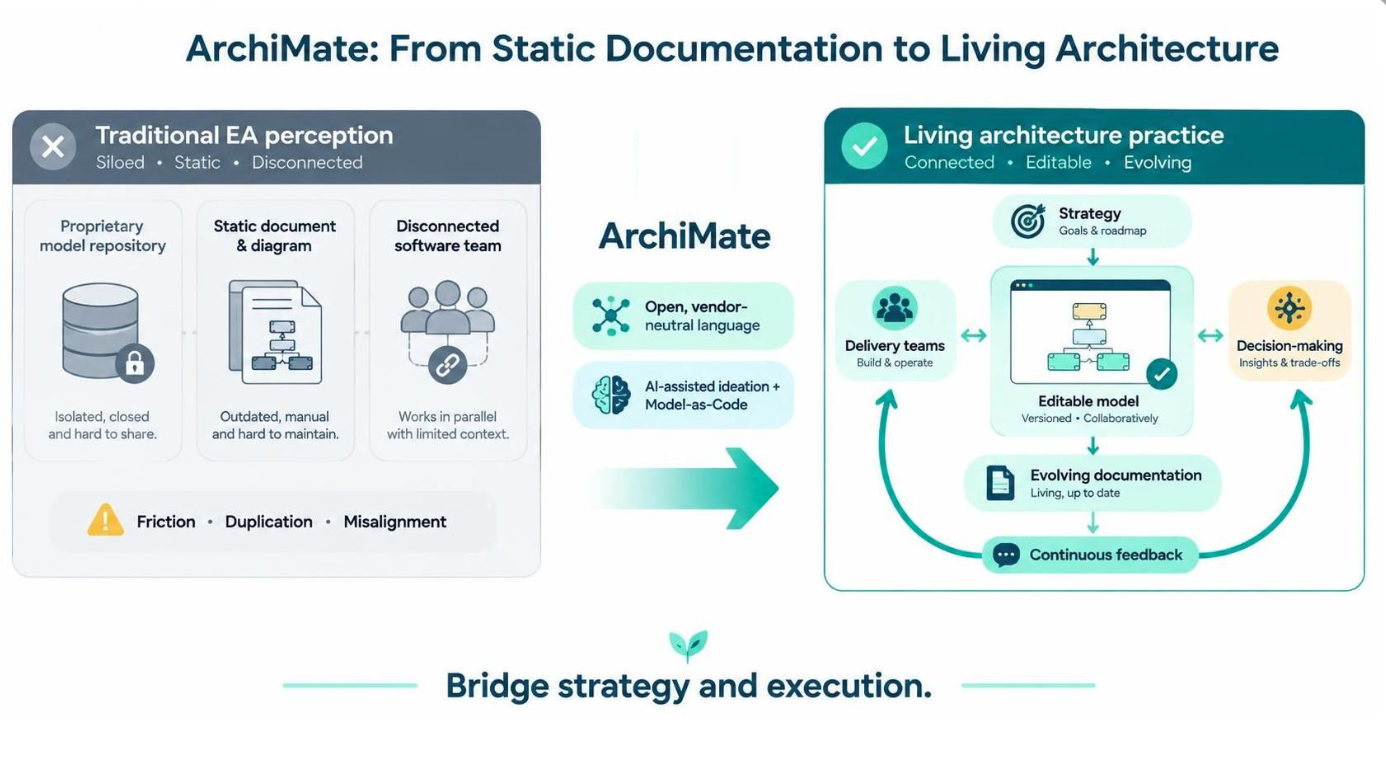
Enterprise Architecture (EA) has long struggled with a perception problem: it is often seen as slow, bureaucratic, and disconnected from the rapid pace of software delivery. Traditional EA tools, while powerful, frequently create silos where models live in proprietary repositories, inaccessible to developers and difficult to version-control.
Enter ArchiMate, an open, vendor-neutral modeling language maintained by The Open Group. When combined with modern practices like Model-as-Code and AI-assisted ideation, ArchiMate transforms from a static documentation exercise into a dynamic, living asset that drives decision-making. This guide explores how to leverage ArchiMate not just as a notation, but as a comprehensive practice integrated with AI tooling and Visual Paradigm’s ecosystem to bridge the gap between strategy and execution.
1. What ArchiMate Is (and Is Not)
ArchiMate is an open, independent enterprise architecture modelling language. It provides a standardized vocabulary and visual notation to describe, analyze, and visualize the relationships among business domains in an unambiguous way.
Key Distinctions
-
It is NOT a methodology: It does not tell you how to run an EA practice (TOGAF or SAFe does that); it tells you how to draw the results.
-
It is NOT just diagrams: It is a language. Diagrams are merely views onto a single, coherent underlying model.
-
It is NOT BPMN or UML:
-
BPMN details process choreography; ArchiMate shows how processes fit the enterprise.
-
UML details software design; ArchiMate shows the architectural intent above it.
-
The Power of Model vs. View
In ArchiMate, you build one coherent model. Every diagram is a filtered projection (a viewpoint) of that model. This enables true impact analysis: change one element in the repository, and every dependent view updates automatically.
Versions at a Glance
| Version | Year | Notable Additions |
|---|---|---|
| 1.0 | 2009 | Initial core language |
| 2.0 | 2012 | Implementation & Migration layer, Motivation layer |
| 3.0 | 2016 | Strategy layer, Capability & Resource elements, Physical elements |
| 3.1 | 2019 | Value Stream element, refined relationships |
| 3.2 | 2022 | Value stream & capability refinements, improved model exchange |
2. Key Concepts
2.1 The Two Dimensions: Layers × Aspects
The ArchiMate Framework is a grid. Rows are layers of the enterprise; columns are aspects of architecture.
| Passive (Structure) | Behaviour (Process) | Active (Actor) | |
|---|---|---|---|
| Strategy | Resource | Course of Action / Value Stream | Capability |
| Business | Business Object | Business Process / Service | Business Actor / Role |
| Application | Data Object | Application Service / Function | Application Component |
| Technology | Artifact | Technology Service / Function | Node / Device / System Software |
| Physical | Material | — | Equipment / Facility |
| Motivation | Meaning, Value | — | Stakeholder, Driver, Goal, Requirement |
| Implementation | Deliverable | Work Package | Plateau, Gap |
Rule of Thumb: Passive structures are acted upon; Behaviour does the acting; Active structures perform the behaviour.
2.2 Core Elements by Layer
-
Strategy Layer: Focuses on Capabilities (abilities to achieve outcomes), Resources, and Value Streams (sequences of value-adding stages).
-
Business Layer: Models Actors, Processes, Services, and Objects (e.g., invoices, contracts).
-
Application Layer: Defines Components (software units), Services (exposed behavior), and Data Objects.
-
Technology Layer: Describes Nodes (servers/VMs), System Software (OS/DB), and Artifacts (deployed files).
-
Motivation Layer: Captures the Why: Stakeholders, Drivers, Goals, Requirements, and Principles.
-
Implementation & Migration: Manages change via Work Packages, Deliverables, Plateaus (transition states), and Gaps.
2.3 Relationships: The Grammar
Relationships define how elements interact. Critical rules include:
-
Serving: Flows upward across layers (e.g., Technology serves Application).
-
Realization: Flows from lower layer to higher layer (e.g., Application Component realizes Business Service).
-
Composition/Aggregation: Whole-part relationships within a layer.
-
Assignment: Active structure performs behavior.
Derivation Rule: If A serves B and A realizes C, then C serves B. Do not draw the implied edge to keep diagrams clean.
2.4 Viewpoints
A viewpoint is a contract with the audience, selecting only relevant elements for a specific concern. Examples include:
-
Layered Architecture: Full realization chain from Motivation to Technology.
-
Capability Map: Hierarchical decomposition of enterprise abilities.
-
Value Stream: Customer-facing stages mapped to capabilities.
-
Migration: Baseline to target state transitions.
3. Use Cases by Domain
ArchiMate is domain-neutral, but its application varies by sector:
3.1 Financial Services & Insurance
-
Focus: Regulatory compliance, legacy rationalization, risk.
-
Key Views: Value Stream (Loan origination, Claims handling), Product (bundling services), Layered Architecture (regulatory reporting chains).
-
Benefit: Maps statutory mandates (Requirements) directly to database fields for audit traceability.
3.2 Government & Public Sector
-
Focus: Cross-agency interoperability, citizen service delivery.
-
Key Views: Business Process Cooperation (citizen journeys across agencies), Requirements Realization (mapping laws to services).
3.3 Healthcare & Life Sciences
-
Focus: Clinical pathways, data privacy, interoperability (HL7/FHIR).
-
Key Views: Information Structure (clinical data ownership), Technology Usage (data residency compliance).
3.4 Manufacturing & Industry 4.0
-
Focus: OT/IT convergence, plant topology.
-
Key Views: Physical Layer (Equipment, Facilities), Implementation & Deployment (MES vs. PLC placement).
3.5 Retail & E-commerce
-
Focus: Omnichannel consistency, partner ecosystems.
-
Key Views: Value Stream (Discover → Buy → Fulfil), Application Cooperation (integration mesh of PIM, OMS, CRM).
4. Diagram Examples (ArchiMate-PlantUML)
Below are renderable examples using the ArchiMate-PlantUML standard library. These demonstrate how to model complex architectures as code.
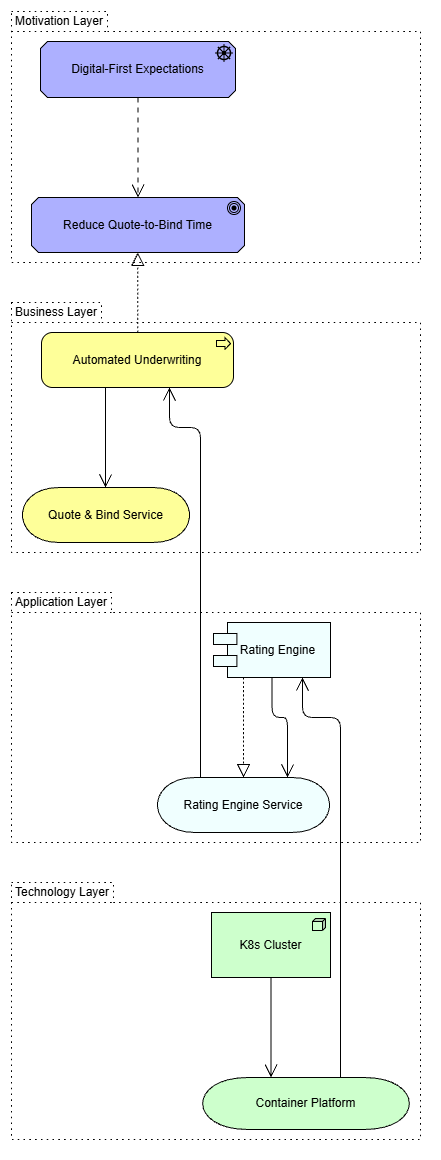
4.1 Layered Architecture Blueprint
The single most valuable view, tracing from strategic driver to infrastructure.
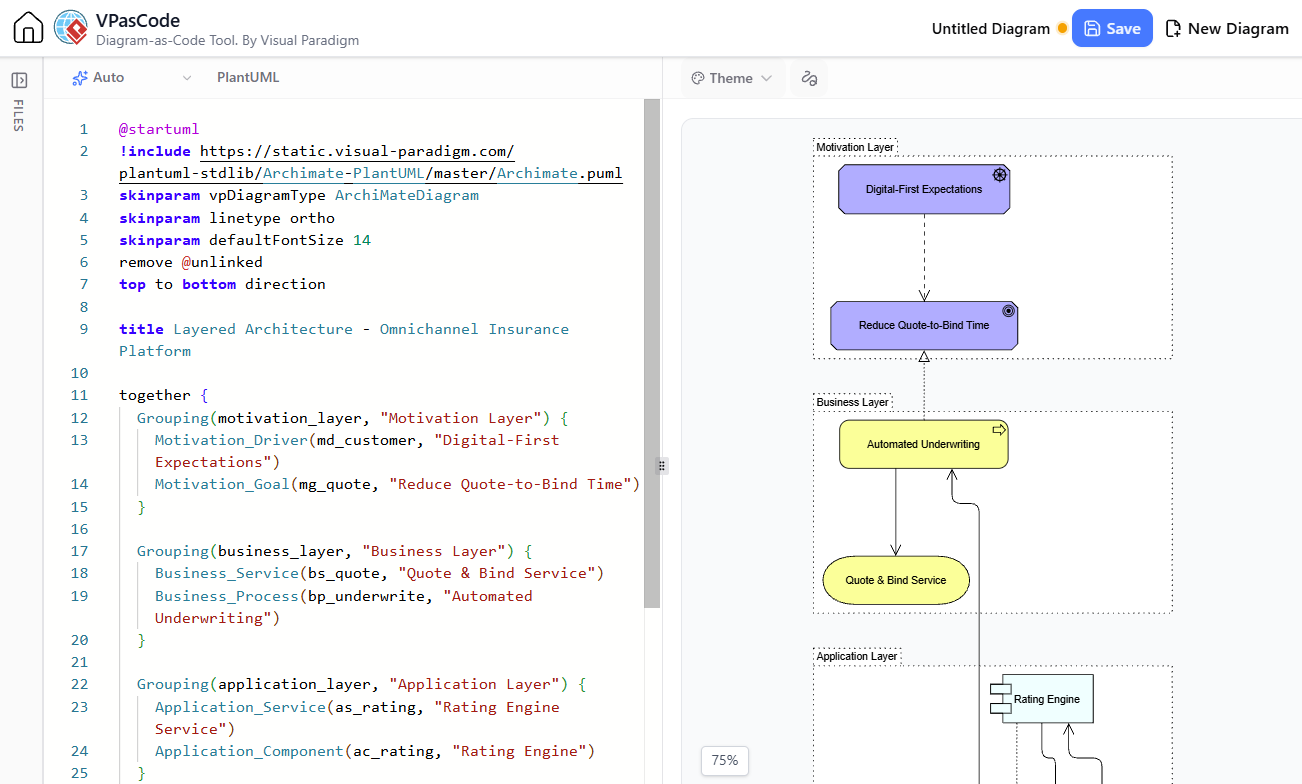
@startuml
!include https://static.visual-paradigm.com/plantuml-stdlib/Archimate-PlantUML/master/Archimate.puml
skinparam vpDiagramType ArchiMateDiagram
skinparam linetype ortho
skinparam defaultFontSize 14
remove @unlinked
top to bottom direction

title Layered Architecture - Omnichannel Insurance Platform

together {
  Grouping(motivation_layer, "Motivation Layer") {
    Motivation_Driver(md_customer, "Digital-First Expectations")
    Motivation_Goal(mg_quote, "Reduce Quote-to-Bind Time")
  }

  Grouping(business_layer, "Business Layer") {
    Business_Service(bs_quote, "Quote & Bind Service")
    Business_Process(bp_underwrite, "Automated Underwriting")
  }

  Grouping(application_layer, "Application Layer") {
    Application_Service(as_rating, "Rating Engine Service")
    Application_Component(ac_rating, "Rating Engine")
  }

  Grouping(technology_layer, "Technology Layer") {
    Technology_Service(ts_kubernetes, "Container Platform")
    Technology_Node(tn_cluster, "K8s Cluster")
  }
}

Rel_Influence_Down(md_customer, mg_quote, "")
Rel_Realization_Up(bp_underwrite, mg_quote, "")
Rel_Serving_Up(bp_underwrite, bs_quote, "")
Rel_Serving_Up(ac_rating, as_rating, "")
Rel_Realization_Up(ac_rating, as_rating, "")
Rel_Serving_Up(as_rating, bp_underwrite, "")
Rel_Serving_Up(tn_cluster, ts_kubernetes, "")
Rel_Serving_Up(ts_kubernetes, ac_rating, "")
@enduml
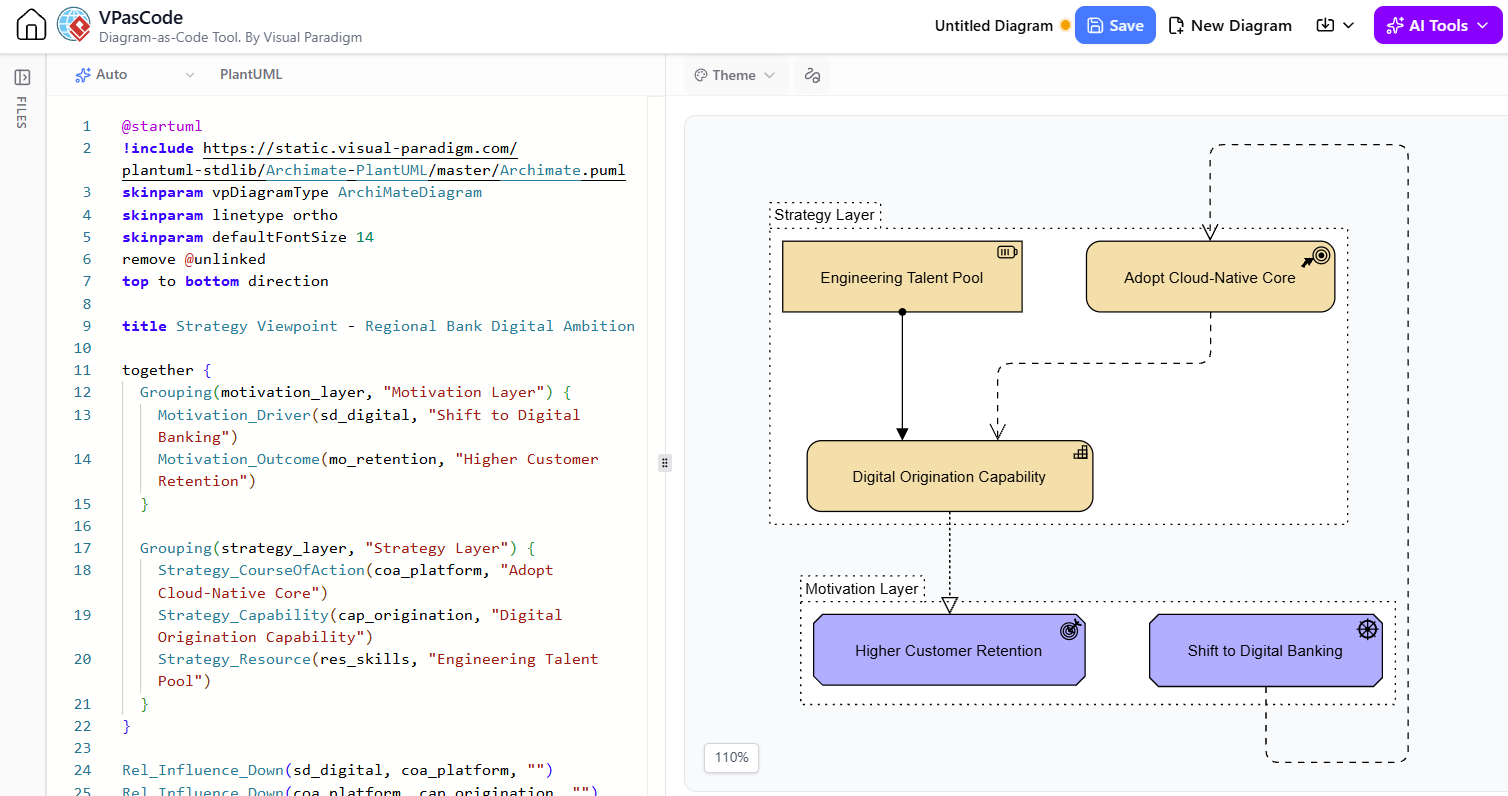
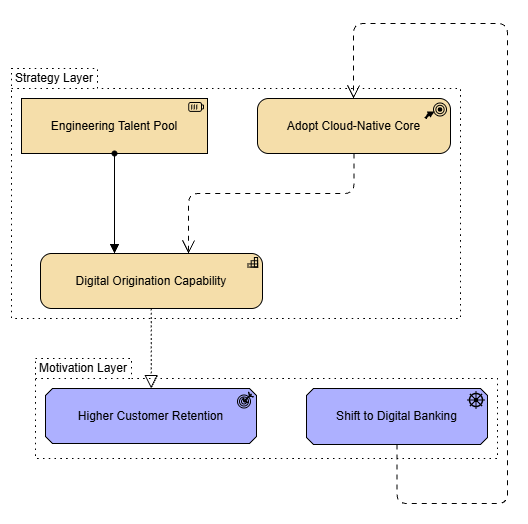
4.2 Strategy Viewpoint: From Driver to Outcome
Shows how strategic drivers shape courses of action and capabilities.
@startuml
!include https://static.visual-paradigm.com/plantuml-stdlib/Archimate-PlantUML/master/Archimate.puml
skinparam vpDiagramType ArchiMateDiagram
skinparam linetype ortho
skinparam defaultFontSize 14
remove @unlinked
top to bottom direction

title Strategy Viewpoint - Regional Bank Digital Ambition

together {
  Grouping(motivation_layer, "Motivation Layer") {
    Motivation_Driver(sd_digital, "Shift to Digital Banking")
    Motivation_Outcome(mo_retention, "Higher Customer Retention")
  }

  Grouping(strategy_layer, "Strategy Layer") {
    Strategy_CourseOfAction(coa_platform, "Adopt Cloud-Native Core")
    Strategy_Capability(cap_origination, "Digital Origination Capability")
    Strategy_Resource(res_skills, "Engineering Talent Pool")
  }
}

Rel_Influence_Down(sd_digital, coa_platform, "")
Rel_Influence_Down(coa_platform, cap_origination, "")
Rel_Realization_Up(cap_origination, mo_retention, "")
Rel_Assignment(res_skills, cap_origination, "")
@enduml
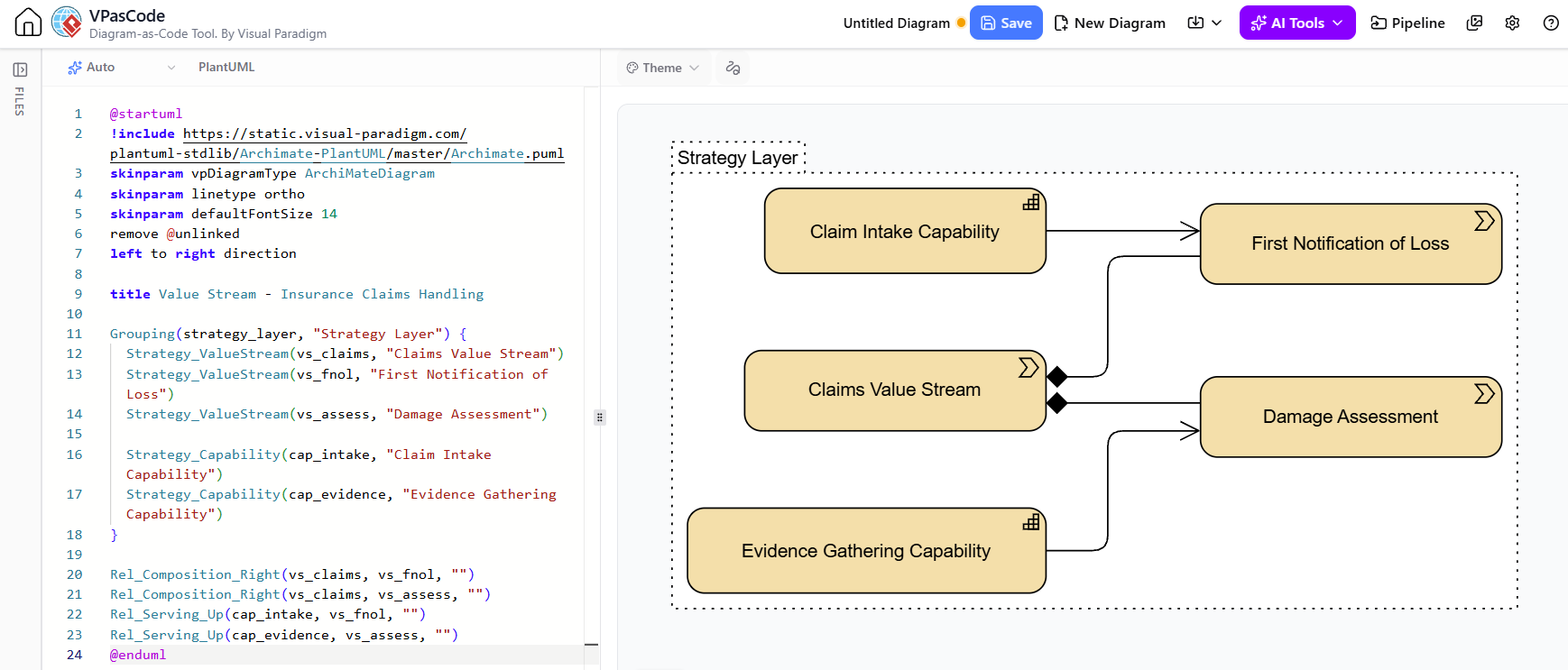
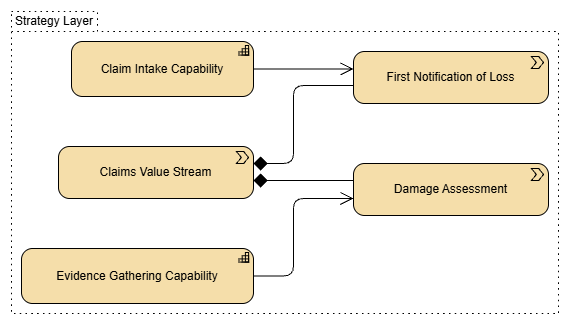
4.3 Value Stream: Customer-Facing Stages
Maps stages to capabilities, bridging strategy and operations.
@startuml
!include https://static.visual-paradigm.com/plantuml-stdlib/Archimate-PlantUML/master/Archimate.puml
skinparam vpDiagramType ArchiMateDiagram
skinparam linetype ortho
skinparam defaultFontSize 14
remove @unlinked
left to right direction

title Value Stream - Insurance Claims Handling

Grouping(strategy_layer, "Strategy Layer") {
  Strategy_ValueStream(vs_claims, "Claims Value Stream")
  Strategy_ValueStream(vs_fnol, "First Notification of Loss")
  Strategy_ValueStream(vs_assess, "Damage Assessment")

  Strategy_Capability(cap_intake, "Claim Intake Capability")
  Strategy_Capability(cap_evidence, "Evidence Gathering Capability")
}

Rel_Composition_Right(vs_claims, vs_fnol, "")
Rel_Composition_Right(vs_claims, vs_assess, "")
Rel_Serving_Up(cap_intake, vs_fnol, "")
Rel_Serving_Up(cap_evidence, vs_assess, "")
@enduml
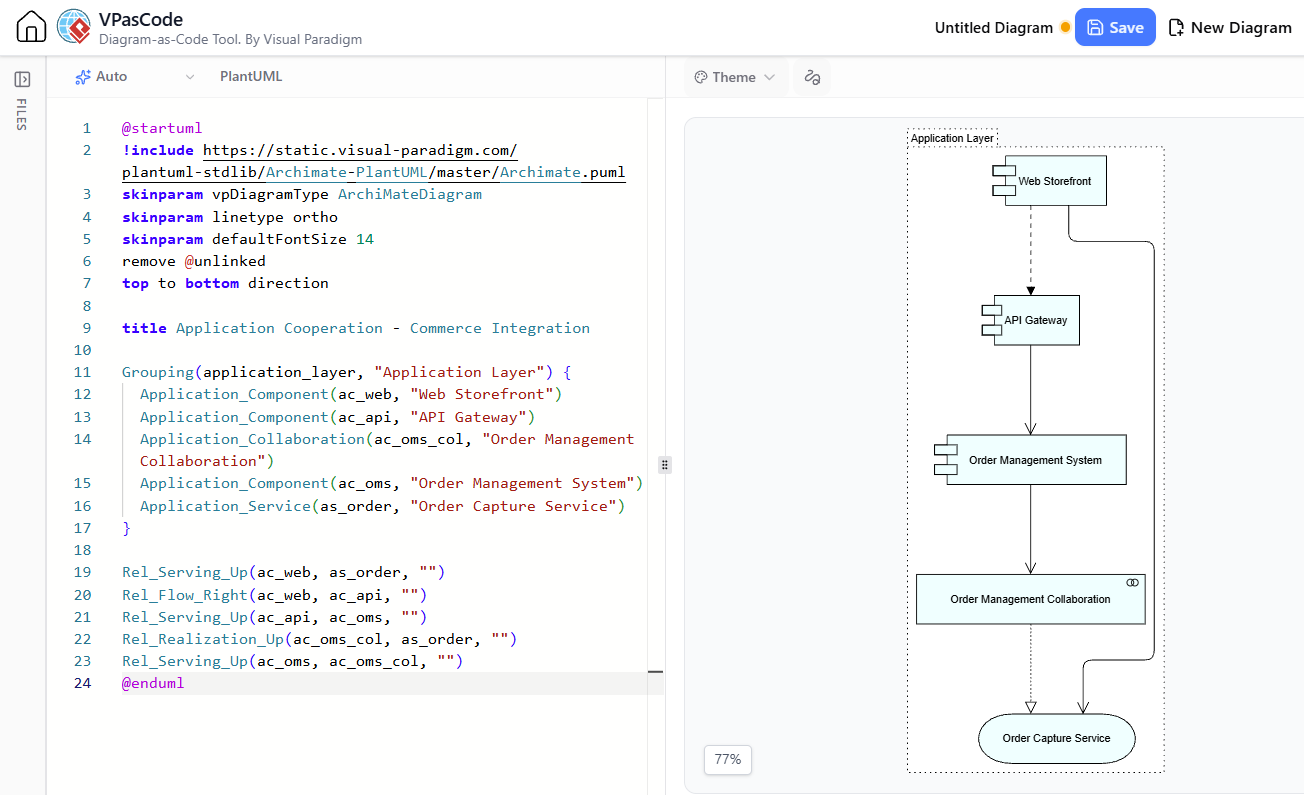
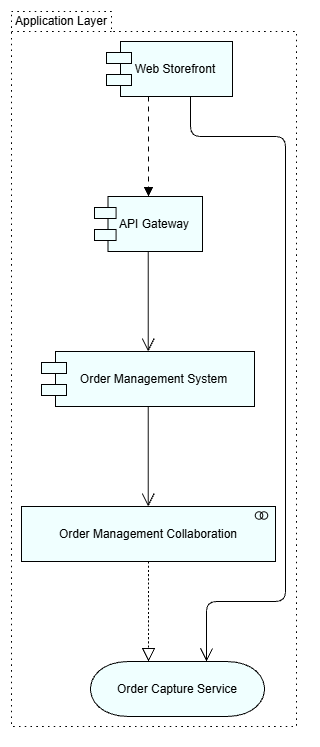
4.4 Application Cooperation: The Integration Mesh
Depicts how applications cooperate, ignoring internal workings.
@startuml
!include https://static.visual-paradigm.com/plantuml-stdlib/Archimate-PlantUML/master/Archimate.puml
skinparam vpDiagramType ArchiMateDiagram
skinparam linetype ortho
skinparam defaultFontSize 14
remove @unlinked
top to bottom direction

title Application Cooperation - Commerce Integration

Grouping(application_layer, "Application Layer") {
  Application_Component(ac_web, "Web Storefront")
  Application_Component(ac_api, "API Gateway")
  Application_Collaboration(ac_oms_col, "Order Management Collaboration")
  Application_Component(ac_oms, "Order Management System")
  Application_Service(as_order, "Order Capture Service")
}

Rel_Serving_Up(ac_web, as_order, "")
Rel_Flow_Right(ac_web, ac_api, "")
Rel_Serving_Up(ac_api, ac_oms, "")
Rel_Realization_Up(ac_oms_col, as_order, "")
Rel_Serving_Up(ac_oms, ac_oms_col, "")
@enduml
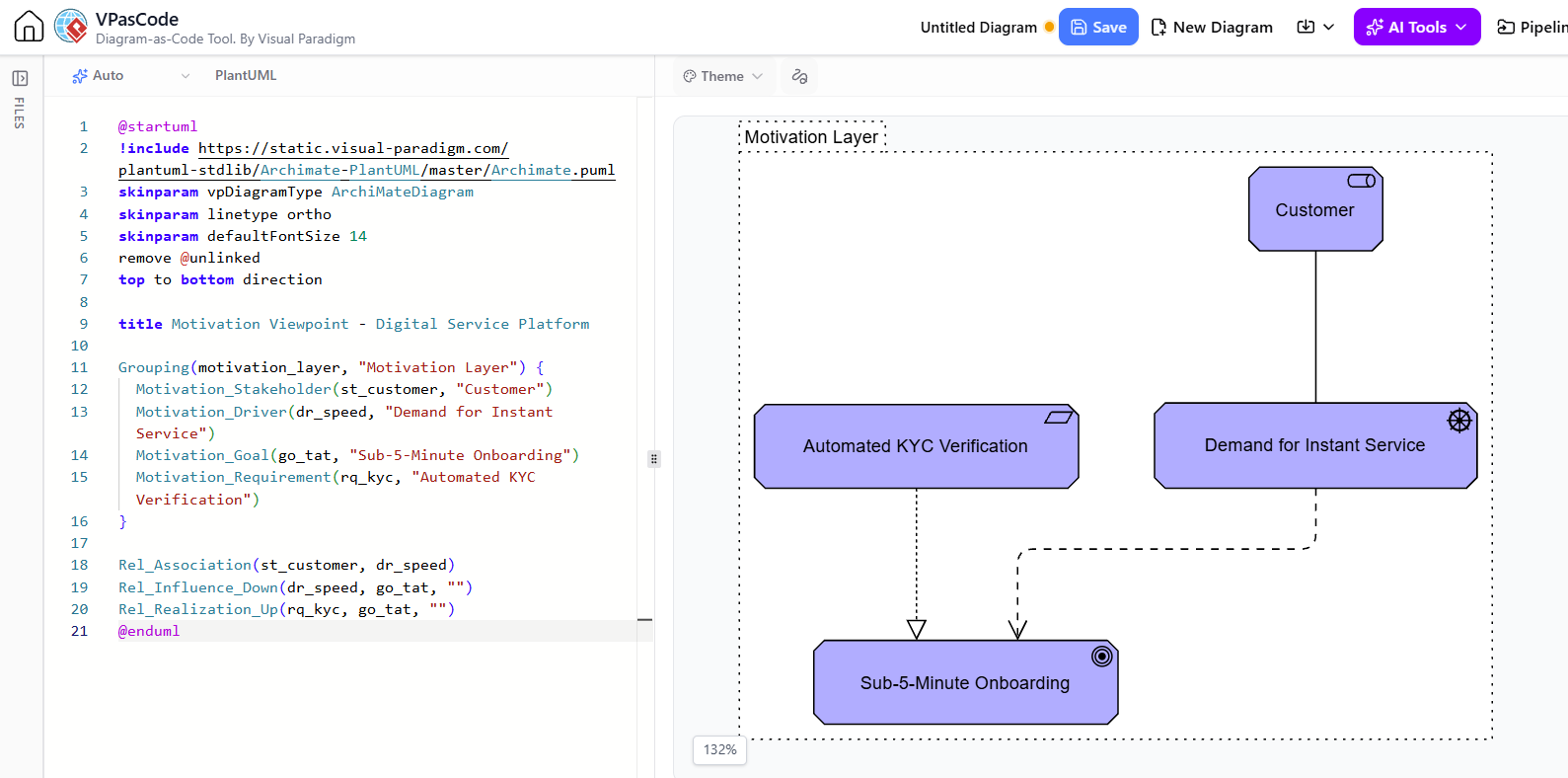
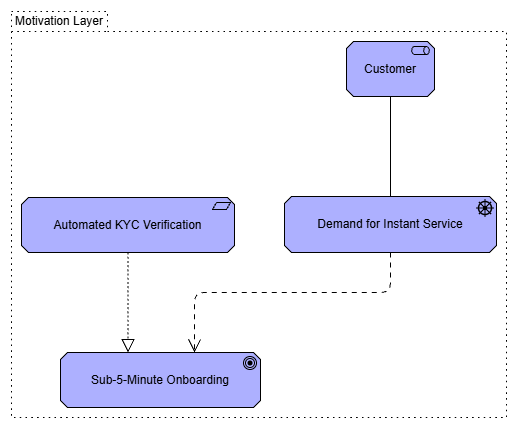
4.5 Motivation Viewpoint: Goal Tree
Links stakeholders to requirements via goals and drivers.
@startuml
!include https://static.visual-paradigm.com/plantuml-stdlib/Archimate-PlantUML/master/Archimate.puml
skinparam vpDiagramType ArchiMateDiagram
skinparam linetype ortho
skinparam defaultFontSize 14
remove @unlinked
top to bottom direction

title Motivation Viewpoint - Digital Service Platform

Grouping(motivation_layer, "Motivation Layer") {
  Motivation_Stakeholder(st_customer, "Customer")
  Motivation_Driver(dr_speed, "Demand for Instant Service")
  Motivation_Goal(go_tat, "Sub-5-Minute Onboarding")
  Motivation_Requirement(rq_kyc, "Automated KYC Verification")
}

Rel_Association(st_customer, dr_speed)
Rel_Influence_Down(dr_speed, go_tat, "")
Rel_Realization_Up(rq_kyc, go_tat, "")
@enduml
5. Modelling Patterns Worth Knowing
-
The Canonical Chain:
Capability→Process→Service→Application→Node. If your model breaks this chain (e.g., an Application with no Node), you have found an architecture smell. -
Plateau-Forcing Rule: Every implementation work package must realize a Plateau, Deliverable, or Capability. A work package realizing nothing is a project with no architectural impact.
-
Driver-to-Node Thread: Pick one strategic driver and trace it down to one server. If the chain breaks, the strategy is unsupported. This is the fastest value ArchiMate provides.
-
Avoid “Spaghetti Realization”: Do not draw both
A serves BandA realizes CandC serves B. The third is derived. Filter derived relationships to keep diagrams readable.
6. Tooling: The Visual Paradigm ArchiMate Ecosystem
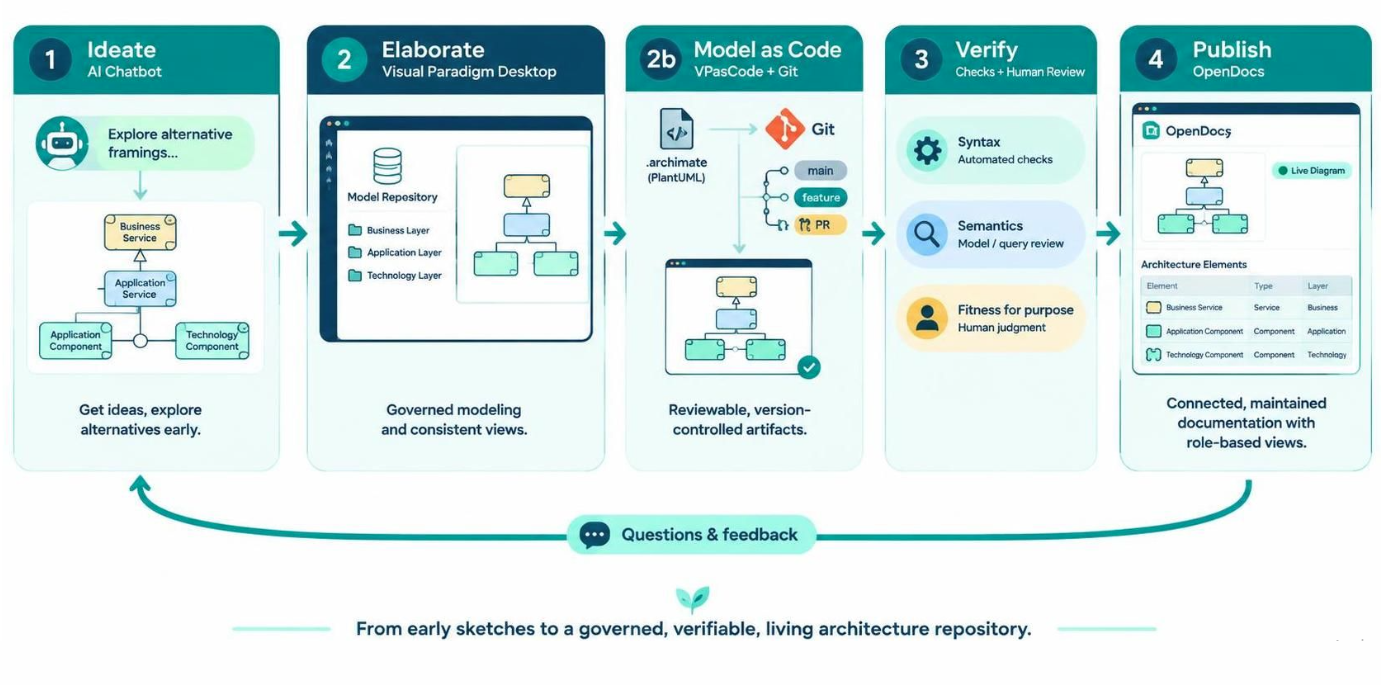
A modeling language without tooling produces pictures. With the right tooling, it produces an asset: a queryable, version-controlled repository. Visual Paradigm covers the entire lifecycle through four stages.
Stage 1: Ideation (AI Chatbot)
-
Problem: Architects often skip exploration and jump to solutions because drafting is expensive.
-
Solution: Use the Visual Paradigm AI Chatbot to generate ArchiMate-PlantUML code from plain language prompts.
-
Workflow: Describe the problem (“We need to replace our policy admin system”), ask for candidate framings (Capability Gap, Value Stream), and generate a draft diagram.
-
Benefit: Ideation becomes divergent and cheap. Stakeholders can critique pictures early.
Stage 2: Model-Based Elaboration (Visual Paradigm Desktop)
-
Tool: Visual Paradigm Desktop ArchiMate Tool.
-
Features: Full ArchiMate 3.2 palette, native relationship semantics, and 27+ standard viewpoints.
-
Repository Advantage: Single source of truth. Rename once, update everywhere. Impact analysis is a query, not a meeting.
-
Hybrid Approach: Use Chatbot/PlantUML for rapid drafting, then import into Visual Paradigm Desktop for governed modeling and cross-viewpoint consistency.
Stage 2b: Model-as-Code (VPasCode)
-
Concept: Architecture artifacts live in Git alongside software code.
-
Benefits:
-
Diffable: Architecture changes show up in pull requests.
-
Reviewable: Reviewers see semantic changes, not binary file swaps.
-
Testable: Diagrams build in CI; broken references fail the build.
-
-
Workflow: Commit ArchiMate-PlantUML text files to Git. VPasCode renders them deterministically.
Stage 3: Verification & Modification
-
Level 1 (Syntactic): Automated checks for legal element types and relationships (via VPasCode build or Desktop validation).
-
Level 2 (Semantic): Tool-assisted queries for orphan elements, unrealized work packages, or missing host nodes. AI can assist in reviewing model completeness.
-
Level 3 (Fitness for Purpose): Human judgment. Does the model answer the stakeholder’s question? Is the abstraction level correct?
Stage 4: Publish (OpenDocs)
-
Problem: Exported PNGs in slide decks go stale immediately.
-
Solution: OpenDocs embeds live model content into documentation.
-
Features:
-
Diagrams are referenced, not copied. Updates propagate automatically.
-
Model queries render as live tables (e.g., Application Landscape Report).
-
Audience-specific publications (Executive Summary vs. Technical Deep Dive) generated from the same model.
-
The End-to-End Workflow
-
Ideate with AI Chatbot (sketch options).
-
Model in Visual Paradigm Desktop (governed repository) or VPasCode (Git).
-
Verify via automated checks and AI review.
-
Publish via OpenDocs (living documentation).
-
Feedback Loop: Published views trigger new questions, which feed back into Ideation.
Conclusion
ArchiMate, when paired with modern tooling like Visual Paradigm’s AI Chatbot, VPasCode, and OpenDocs, transcends traditional enterprise architecture. It moves EA from a static, document-heavy practice to a dynamic, code-integrated discipline. By treating architecture as code, organizations can ensure their models are version-controlled, reviewable, and always in sync with reality. The result is not just better diagrams, but a resilient architectural practice that survives personnel changes and actively drives strategic decision-making.